NeurIPS 2026
Leveraging Dale’s Principle as an Inductive Bias in Recurrent Neural Networks
NeurIPS 2026 · Accepted
Learnable excitatory–inhibitory separation improves recurrent learning stability, continual learning, and reinforcement learning control.
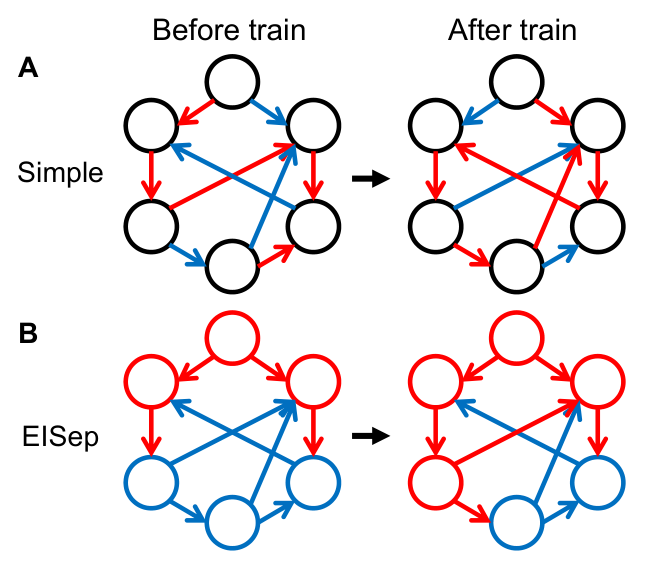
Figure 1: EISep learns excitatory–inhibitory neuron identities while preserving Dale’s principle.
A biological principle for more stable learning
Biological neurons send either excitatory or inhibitory outputs. EISep RNN incorporates this constraint, known as Dale’s principle, into recurrent networks while allowing each neuron’s excitatory or inhibitory identity to be learned.
Method
The architecture combines a learnable sign assignment using Gumbel–Softmax. These choices let the network adapt its excitatory–inhibitory organization during training while improving optimization stability.
Experimental findings
- Multi-task learning: competitive performance on a 20-task cognitive benchmark, with more stable gradients and recurrent dynamics.
- Continual learning: reduced task interference and stronger resistance to catastrophic forgetting across sequential cognitive tasks.
- Reinforcement learning: improved recurrent advantage actor–critic performance on Lunar Lander and HalfCheetah, covering discrete and continuous control.
- Interpretable structure: sparse, modular connectivity emerges from the excitatory–inhibitory constraint.
Research connection
Reliable policy learning depends on stable optimization and representations that can be reused across tasks. This work explores architectural inductive biases for those properties.
Interested in this research?
Get in touch ↗