NeurIPS 2026
Learning Reusable Motor Motifs for Continuous Animal Behavior Modeling
NeurIPS 2026 · Accepted
Discovering reusable motor motifs from offline behavior data and composing them into continuous, interpretable policies.
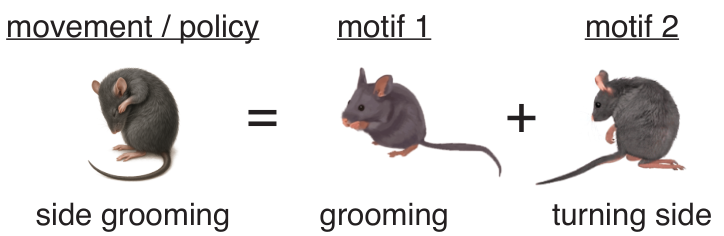
Figure 1: complex behaviors emerge from combinations of reusable motor motifs.
Learning the building blocks of behavior
Complex movements often combine simpler components: an animal can turn while grooming, or sniff while moving forward. Motif-based Continuous Dynamics (MCD) learns these reusable motor motifs directly from behavioral trajectories and models behavior as smoothly changing combinations of them.
Method
- Learn from offline trajectories. Use transition-based spectral representation learning to discover a shared basis for dynamics, policies, and rewards.
- Compose skills continuously. Represent behavior through time-varying motif weights, allowing multiple motifs to be active together.
- Infer policies and reward structure. Connect the learned representation to maximum-entropy policies and inverse reinforcement learning.
Experimental findings
Evaluated on simulated gridworlds, maze navigation, and real animal behavior data. On the animal behavior benchmark, MCD outperforms Keypoint-MoSeq, SemiSeg, and OPAL in human-annotated behavior decoding accuracy and trajectory discrimination AUC. The learned motifs capture both transitions and simultaneous movements, such as locomotion and sniffing.
Research connection
This work studies how reusable, compositional skills can be extracted from observed behavior. It informs my broader interest in learning embodied skills from demonstrations. The experiments in this paper concern simulated tasks and animal behavior; transferring this approach to human motion and robots is a future research direction.
Interested in this research?
Get in touch ↗